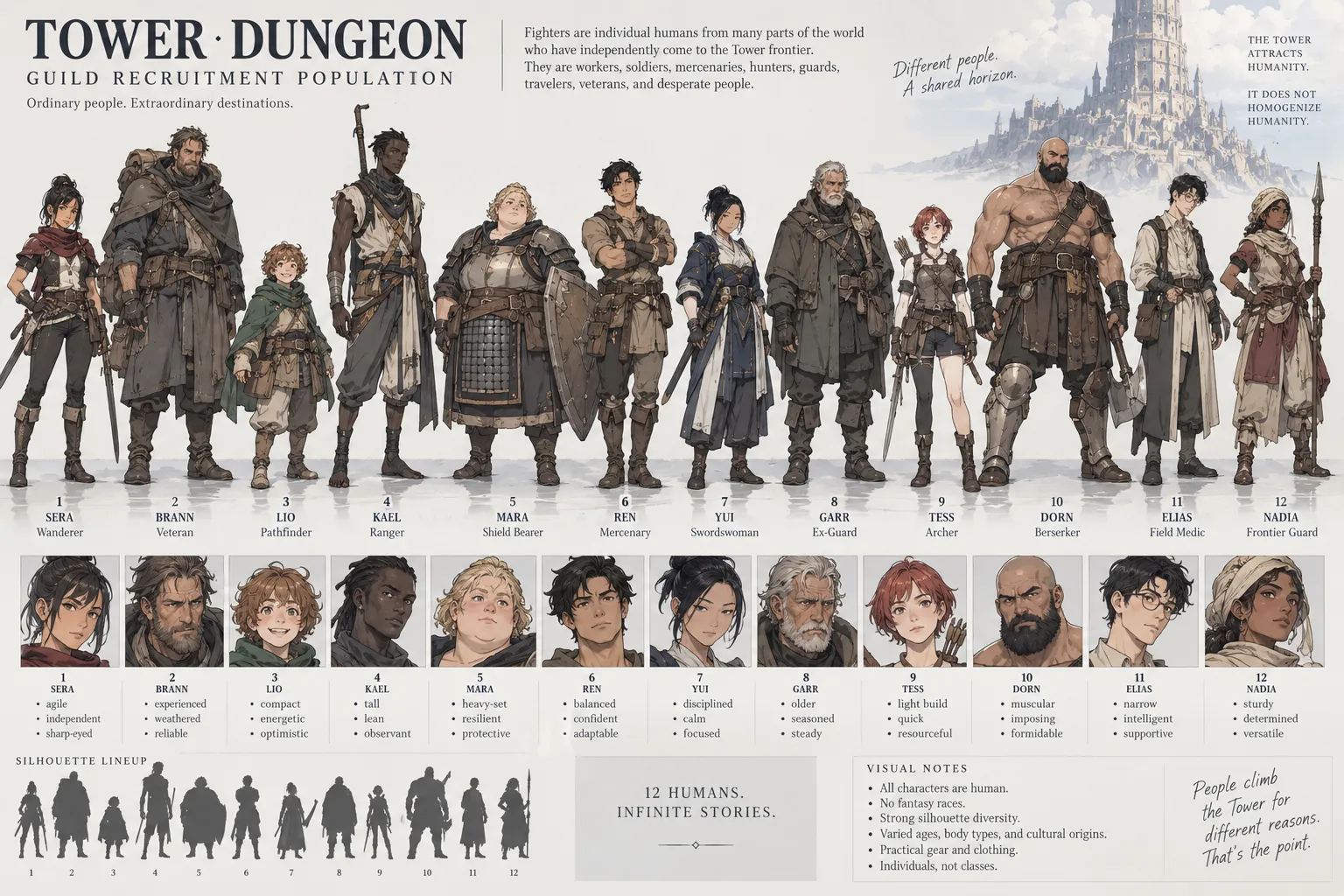
Guild recruitment commonly offers 10+ fighters. Recognizable fantasy/historical roles and cultural clichés are allowed when they communicate gameplay efficiently. The universe does not need to reinvent every archetype.
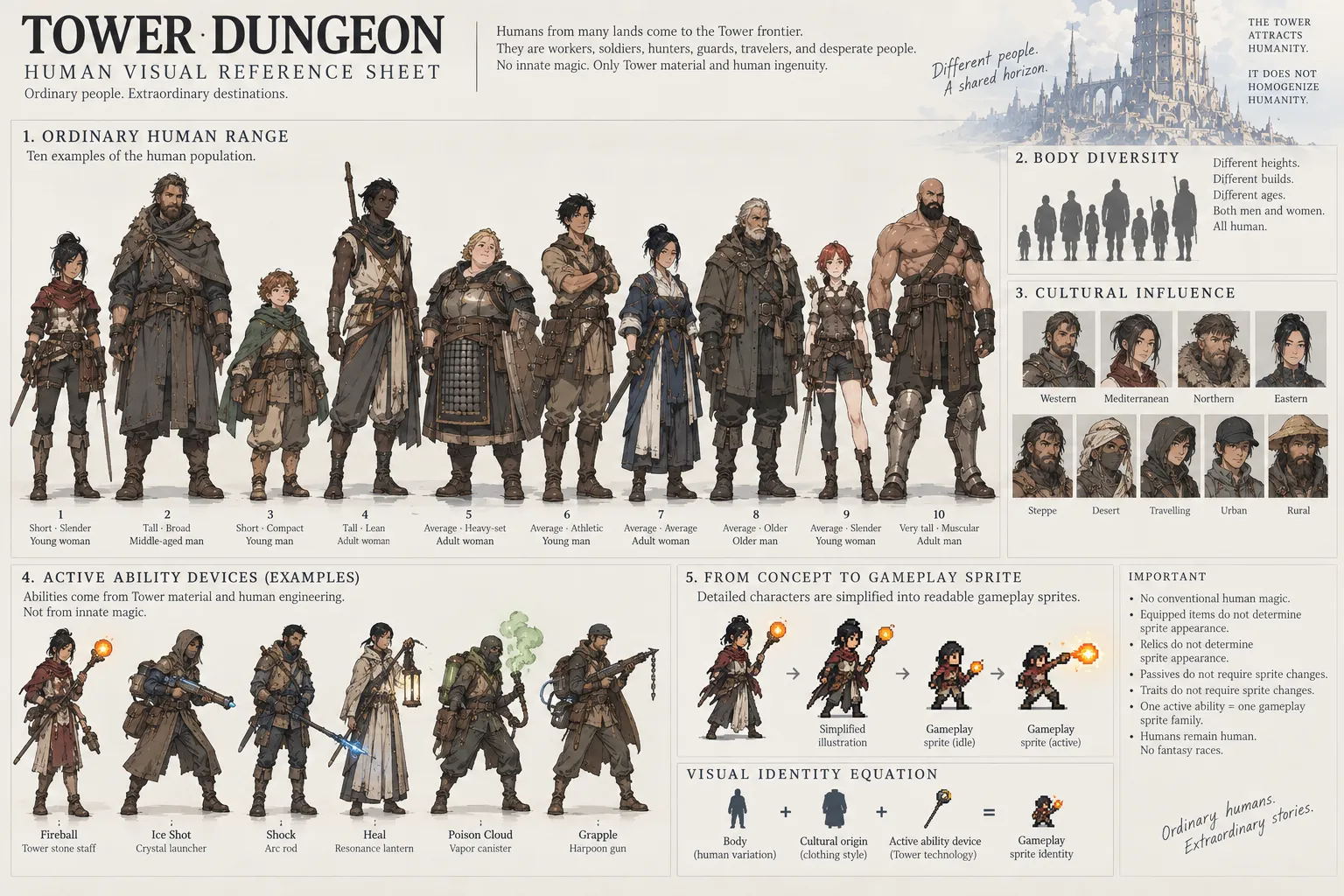
Humans vary strongly in height, corpulence, age, sex, culture, armor, weapon and posture. Amended D-441 Median gameplay anatomy: about 7--8 heads, grounded and realistic, with variation by body. Full plate exists. Human-made weapons normally use realistic proportions. No conventional spellcaster visual language unless explicitly established later. Amended D-311 Established: a mage may look like a classic fantasy mage; what they carry is a device (§28).
Amended D-291, D-293, D-294, D-307 - Everyone is human. There are no other peoples, and no one has magic. A healer uses creature-derived medicine; a fire-thrower carries a device of hot Tower stone (GAMEPLAY §7). Amended D-311 The frontier still calls them a hedge-witch and a pyromancer (§28).
- They come from every realm (§25), and their faces, dress and names follow the realm they came from (§32).
- They climb for every reason: debt, poverty, exile, faith, fame, a lost relative, boredom. The frontier gathers the desperate and the ambitious alike. A recruit's Traits hint at which.
PRODUCTION RULE: each recruit needs one canonical gameplay appearance, not separate early/mid/veteran sprites. Sprites communicate role, body, silhouette and general identity, not exact inventory. Gameplay faces are anonymous at distance; portraits can show full identity.
Amended D-080 The gameplay appearance is one sprite per Active: everyone with the same Active looks the same in combat, apart from a palette tint. The diversity above lives across Actives and in the portraits, which come from an offline library (D-081).